Programme
Saturday 18 July, 10:30 | Sádky – tent (web)
- Secretly Alive: Embodied Perspectives on Dance Improvisation | Mirka Eliášová, Mish Rais | Editors Mish Rais, Mirka Eliášová and Lizzy Le Quesne offer an overview – unique in the Czech context – of dance improvisation and instant composition as an independent art form.
- Dance – Actividary | Zden Brungot Svíteková | Inês Fonseca Santos’s book, illustrated by André Letria, in a Czech edition published by collective Ostružina in collaboration with Zden Brungot Svítekovou and Barborou Látalovou, opens up the world of dance to young readers, teenagers and adults through entries, illustrations and movement tasks.
- Orbis cirkus | Ondřej Cihlář | Ondřej Cihlář and Hanuš Jordan map the transformation of circus in the Czech lands, from traditional forms to new circus and its current iterations.
Sunday 19 July, 10:30 | Sádky – tent (web)
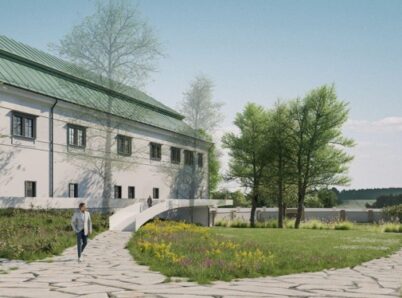
- The Most Beautiful Metres Are Those That Are Not Built | Gilles Marty | Architect Gilles Marty, who designed the renovation of the convent for the new Cultural Creative Centre, presents his manifesto on architecture that is less about building than about finding the roots of the site.
- Light and the Exhibition Space | Pavla Beranová | Author Pavla Beranová explores light as a means of creating atmosphere, telling stories, drawing attention and interpreting space.
Featured books and their authors
Mish Rais, Mirka Eliášová and Lizzy Le Quesne (eds.)
Secretly Alive / Tajně naživu
CZ / EN / AMU Press / NAMU
In Secretly Alive, dance artists Mish Rais, Mirka Eliášová and Lizzy Le Quesne meet as editors to share the questions and discoveries of the three-year artistic research project Improvisation as Choreographic, Authorial and Creative Principle. The editors invited six renowned artists into the studio and conducted in-depth interviews exploring their embodied practices.
Rosalind Crisp, Julyen Hamilton, Wendy Houstoun, Eva Karczag, Daniel Lepkoff and Nita Little share their diverging and converging journeys to improvisation, their views on pedagogy and instant composition, and their strategies and experiences of making and performing for the stage.
The six interviews are accompanied by essays by each of the three researcher-editors considering dance improvisation’s creative value and potential from different angles: as a choreographic process, a discipline of awareness and a site of relational experimentation. Revealing both histories of improvisation in Western postmodern dance and details of current improvisational practices through the reflections of six major artists, this book will be of use to artist practitioners, students, teachers and audiences of dance improvisation.
Inês Fonseca Santos & André Letria
Dance / Dança
CZ edition: Ostružina
Shall we dance? This book will make you lift your feet off the ground. Be ready for pirouettes, pliés and moonwalks. The rehearsals, markings and the final bow are on us; the cheers are on you.
Following Sea and Theatre, Dance is the third title in the Actividaries collection — a series combining activities and dictionaries — dedicated to an art form as ancient as humanity. From A to Z, each theme is explored through artistic, historical, scientific, philosophical and playful references.
The Czech edition was published by Ostružina.
Ondřej Cihlář, Hanuš Jordan
Orbis Circus
CZ / AMU Publishing House / NAMU
Orbis Circus explores the transformation of circus in the Czech lands, from traditional circus forms to contemporary practices often described as new circus. The authors focus on the specific features of both traditional and new circus in the Czech context and explain, in an accessible way, the reasons for their distinctive development.
The book is divided into two parts. In the first, Hanuš Jordan presents chapters from the history of traditional circus from the mid-eighteenth century, when acrobatic acts began to appear alongside the programmes of Czech itinerant puppeteers, through the stories of major travelling circuses, up to the nationalisation of circus in 1953 and the establishment of the state enterprise Czechoslovak Circuses, Variety and Amusement Parks.
In the second part, Ondřej Cihlář traces the relationship between theatre and circus across different cultural periods, from the interwar avant-garde through the totalitarian era to the present, when these tendencies form part of a broader European movement known as new circus. He also considers the specific Czech features visible in new circus, despite its strong European — and especially French — influences.
The publication includes rich and unique photographic material.
Gilles Marty
Les plus beaux mètres carrés sont ceux que l’on ne construit pas
The Most Beautiful Square Metres Are Those We Do Not Build
FR / Éditions Hermann
This entirely original manifesto for architecture pushes the boundaries of the discipline by imagining an architectural work not as a building, but as the experience of a place, the embodiment of a site and the feeling of a landscape.
It proposes a return to the origins of architecture and to its essence, in order to formulate a new vision of the architect’s profession — one in which “the most beautiful square metres are those we do not build”, but those we reveal, those we enhance, and those with which we attune ourselves, as one tunes an instrument to the music of the world.
An architect for forty years, Gilles Marty is a practitioner, teacher, lecturer and international expert. He has carried out numerous projects enhancing major heritage sites in France and abroad, visited by millions of people. This experience has enabled him to develop an innovative way of thinking about how to conceive and practise architecture in a world undergoing profound change.
Pavla Beranová
Light and the Exhibition Space
JAMU Publishing House
What is the role of light in an exhibition space? How can it be used consciously to support the narrative of an exhibition, emphasise the meaning of exhibits, create atmosphere, or guide visitors’ attention?
Light and the Exhibition Space offers a comprehensive insight into lighting design in the context of exhibition-making. It presents light as a flexible tool that can shape both space and meaning, contribute to the visitor experience, and at the same time help provide the necessary conditions for the preservation of exhibits. The book does not treat light merely as a technical necessity, but above all as a medium of presentation and storytelling.
Drawing on her experience as both a lighting designer and a visitor to museums and galleries, the author shows how light affects the atmosphere and interpretation of an exhibition. She emphasises the need to integrate lighting thoughtfully into architectural and curatorial thinking.
The theoretical framework is complemented by case studies, interviews with practitioners and analyses of specific exhibitions. The publication is intended for everyone interested in light, space and visual storytelling in exhibition practice.