Museography Choreography: A Commission for a Choreographic Work (Alice Chauchat)
I was invited to respond by means of choreography to the very ambitious exhibition “1939–2021: The End of the Black-and-White Era”, working with dance artists from Prague and in dialogue with curator Michal Novotný. The exhibition displays exclusively works from the NGP collection, which bear witness to the history of the country and the life of the visual arts in that history, as well as to the history of the institution itself, at the intersection of both. The exhibition traces the movements across these spheres, interrogating the distinction between collective and individual and the related notion of what we consider (artistic) freedom.
Museography Choreography: Zakázka na choreografické dílo (Alice Chauchat)
🇨🇿 READ IN CZECH | Byla jsem oslovena, abych se ve spolupráci s tanečními umělkyněmi z Prahy a v dialogu s kurátorem Michalem Novotným pokusila choreografickými prostředky odpovědět na ambiciózní výstavu 1939–2021: Konec černobílé doby. Výstava se vyznačuje tím, že jsou zde k vidění výhradně díla ze sbírek Národní galerie Praha. Tím nejen svědčí o dějinách národa, ale také o osudech výtvarného umění v rámci těchto dějin a konečně i o samotné galerijní instituci coby křižovatce obou. Výstava sleduje pohyby napříč těmito sférami, zpochybňuje dělení na kolektivní a individuální a současně i spřízněný pojem (umělecké) svobody.
The overwhelming number of works and possible readings offered by the selection, the layout and the scenography, as well as my own lack of knowledge of Czech artistic and political history, made this invitation challenging. Instead of zooming in on one section of the show, I chose to anchor my choreographic response in two aspects which cut across the whole exhibition:
– The insistent making and undoing of categories. Categories help us to navigate the world by distinguishing and connecting, yet they only allow for a partial and sometimes violently redacted view of the realities to which they are applied.
The blurring of the notion of quality. How can quality be felt as situated and therefore unstable, rather than imposed dogmatically by various schools fighting each other?
Body, Archive and Collection
The body accumulates or “collects” without a linear sense of time (unlike museums). Dancers’ bodies carry a wide (museum-like) collection of movements, dances, styles and techniques that merge with their personal physical historiesy. We dance to actualise the archive, in a manner analogous to the way that artworks are actualised through curated exhibiting. The choreographic structure we develop is a mount and a frame for the dance to emerge, rather than represent itself.
The actualisation does not occur through the affirmation of a value system, defining which movements or dances are of quality – appropriate and worthy of being shown (or exhibited). Instead, it happens when we let elements emerge from relational situations, resisting categorical judgements on quality – what responds to what, what resonates with or leans on what? Is this a movement towards or away?, hHow does it create relations and distinctions at the same time?
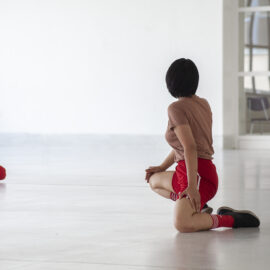
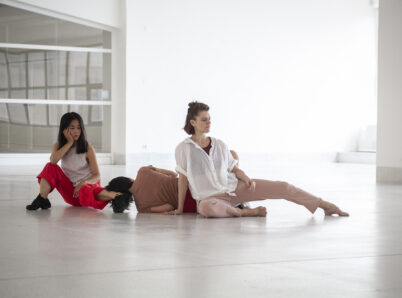
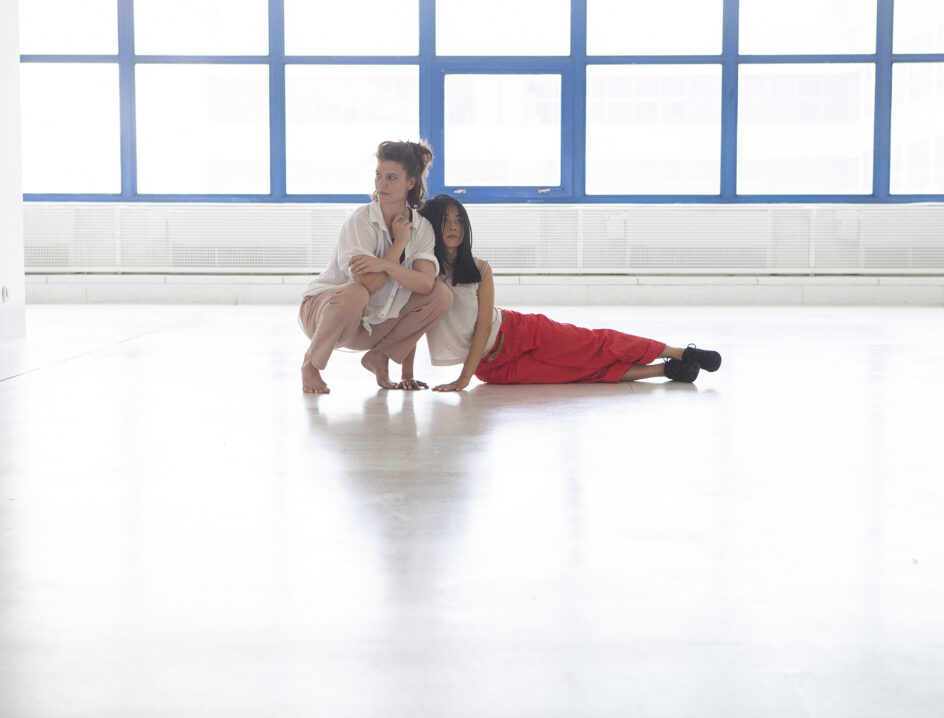
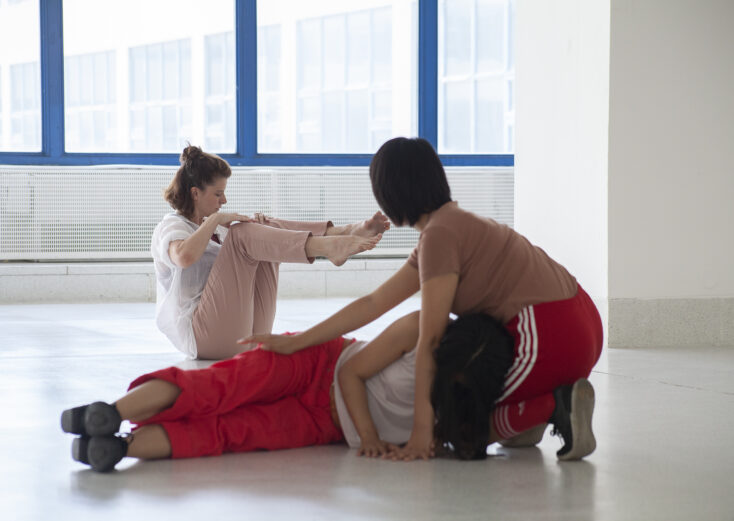
The performers in Museography Choreography, Hana Polanská, Ran Jiao and Nhung Dang, carry distinct and overlapping personal, political and artistic histories: two Czech mothers – two children of Asian parents – three children of socialist states – one educated ballerina – one migrant – one child of migrant parents – one divorcee – one single person – two graduates from an art school. None of those qualifiers suffices to define any dance they will dance but they are part of the currents that can be felt moving across bodies and dances. The work of choreography, in this case, is to emphasise this tangibility while resisting its simplification. Hanka’s, Ran’s and Nhung’s dancing in the piece is never identitarian; identities are but some of the agents which participate in the constitution of a moment. So, each dance appears as the embodiment of a moment – as a momentarily stable (or metastable) result of the agency of their “working” identities.
Radial Temporality … A Very Long, Stretched-out Ending
The dance embodies the moment: how to embody the 82-year-long “era of the black-and-white”? The exhibition displays an ongoing dissolution of binary categories that nevertheless operate discursively and politically, varying across different times, whereby artworks, aesthetics and methodologies are placed in shifting categorisations. These do not disappear but lose their presumed fixity. Projecting the categories into space, as art exhibitions just do by default, or following a linear dramaturgy and suggested reading – whether moving from start to finish or experienced in a piece of performance art unfolding over time – inevitably tends to fix the categories, even if only presumably.
To unfold the presumption of fixity imposed by linear temporality, I work with the dancers on a radial temporality. Through developing a metastable situation from which dances emerge and respond to each other, I stretch time and point the attention to the singularity of each dance. Echoes and contrasts spread across time and the space;, the tension of waiting never resolves. Visitors are invited to spend time with this situation, sense the vibratory field running among the dancers, and observe the dances from afar or up close, as they appear along with the unfolding but often inscrutable relationships between them. The choreography unfolds what is present but rudimentary in the exhibition.
Choreographic Approach: A Play with Unqualified Difference
We work with juxtaposed dance scores, which activate attention to differences and sameness, multiplicity and singularities, bypassing logical analysis. Can we actually notice the differences within multiplicity and the singularity within sameness without the analytic, discriminatory and comparative functions of categories? Or, can we attain this with categorisation tool that is ever-changing in its criteria, as the exhibition “1939–2021: The End of the Black-and-White Era“ does when selecting and grouping the artworks?
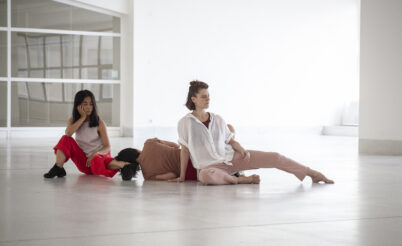
From an undifferentiated, unqualified, pre-categorical, ongoing, and ever-changing base, there emerges a “landscape“ of forms created by the performers’ bodies in the space. Between sculptural compositions and fields of tensions, formal and expressive relationships between bodies are traversed by textural modifications. Stillness vibrates with contrary forces, meteorological nuances and searching gazes. This is also a field for unspoken negotiations. The dancers listen and let dances emerge from temporary configurations, dances that respond to each other in inexplicable logic.