Tom Bailey: Tragedy of Anthropocentric Art. How to Co-create with Trees?
Artistic, artificial – opposed to natural. Ars contra naturam, as the old Latin saying goes. So, isn't art anthropocentric by definition? How can we de-anthropocentrise art? In project Vigil (2018), British choreographer Tom Bailey attempted to embody 26,000 species – though of course, he failed. The classical artistic strategy of mimesis failed too. What remains after an extinct animal is only the name – still a human symbol. – Any reconstruction of the creature, even mimetically re-created, is impossible. Isn’t it equally absurd to perform for trees and animals as Tom Bailey does? Do they even care about our human artistic pursuits? Isn’t this very interview – recorded at the International KoresponDance Festival 2025 in Žďár nad Sázavou, Czechia – itself the real performance, evidence that the ultimate audience of such efforts are people?
As Tom Bailey may suggest: the attempt to de-anthropocentrise art is both insane and absurd. Yet maybe, in such failure – in the inevitable collapse of our anthropocentric endeavours – we reach ground zero, the point where we might reconnect with the non-human. Perhaps art, by its very definition, is a liminal space for exploring the confinements of being human – a point where the artistic transcends artificial. Only when we accept that we can never escape our human point of view can we truly meet nature – no longer needing to interpret, imitate, or possess it, but recognising these projects for what they are: deeply and achingly human attempts to connect.
Tom Bailey is a Bristol-based theatre-maker and artistic director of Mechanimal whose work explores life on a changing planet and new narratives of our anthropocene era, and experiments with new ways of touring performances inspired by the movements of nature itself. His touring brought him to Žďár nad Sázavou, in the rural Vysočina region of Czechia. This interview was recorded at the KoresponDance Festival, where Bailey explored co-creating a performance with a tree as part of the Green Streets of Europe project.
In the conversation, Bailey unfolds his understanding of technology: for him, technology extends beyond the human and so brings us closer to nature; technology is a tool of empathy, not detachment. We also discussed performing outdoors versus indoors, and the practical challenges of creating truly green art.

Technological Empathy
Your company is called Mechanimal – part mechanic, part animal. People often see technology and nature as two separate worlds, something “other” to the human. But you bring them together. How do you bridge these worlds – the technological, the human, and the natural?
For me they’re all one. They’re all nature. We are nature, technology is nature. If we look under the materiality of technology, it’s rocks converted into metal – an extension of a human tool. I’m interested in how technology can expand our perception of nature. For instance, how can technology help us understand tree activity – collect data about what’s going on inside a tree that we can’t see or hear?
The technological aspect is… sounds a bit boring, but it’s working with data, because data lets us see pictures of species extinction, of trees, of rocks – things we can’t otherwise see. Especially now, data opens up a big picture: “Wow – this is the extent of human impact on the planet.” That’s how I work with technology.
How do you feel it’s time to put your technological devices aside?
Yeah. It eats at me – often. It’s great to be able to smash technology as well, and that’s what we do in one project. It’s about controlling your use of technology. Not every project we do has loads of tech. My practice is rooted in the body and in nature – the organic – and that always comes first.
“The technological aspect is … working with data, because data lets us see pictures of species extinction …”
Beyond Human Creativity
Isn’t art, by its very nature, anthropocentric – a human activity made by and for humans? How do you try to shift or decentre the human perspective in your work? Do you think it’s ever possible to access a more-than-human point of view?
In shows we’ve done, technology is a way to make the human very small. In my studio and stage work, the human is insignificant; the nature and the tech are big.
Going forward, I’m increasingly interested in asking whether it’s possible to co-create with nature. I don’t know if it is, but I’m a bit bored of art just for humans. It feels essential to find ways of thinking about creativity beyond human creativity – otherwise it’s very limiting. Nature is arguably very creative; we limit ourselves if we don’t work with that.
Yes, humans have long perceived nature aesthetically, admiring its creativity. But how does it become art? Can we really say that nature makes art as we do?
Becoming art is subjective. The chair is art; the wall is art if I call it art. For instance, the project that I’m working on in the pond – part of Green Streets of Europe – is simply a space to explore: how does the water move? How do the fish move? How do the insects around me move? It’s not “is it art or not”, but “where can I find emergence – a sense of becoming, a creativity, a connection to this place?” Whether it’s art is opinion.
“In shows we’ve done, technology is a way to make the human very small.”
Performing for Trees…
It seems that if we want to de-anthropocentrise art, we need to redefine the very concept of what art is. In a way, that process already began when Duchamp called a chair a work of art. Let me ask – when you performed Vigil, was it actually in forests? Were there spectators? And do you in any way think of trees or animals as your audience?
I performed Vigil to a forest in Norway recently. I don’t know what the trees or animals perceive. They perceive something, but animals’ perceptive capacity is very different to trees. We don’t, as humans, know how trees perceive us. It’s interesting to perform for a tree when you don’t know if the tree can “see” you – like you’re a ghost. You don’t know what the communicative transaction is. Nonetheless, in the act of performing, my perception of trees really changed. Of course, in some way you will affect a tree’s life, but we don’t know how.
Do the trees or reindeer care about your art? Or do they not care at all?
We don’t know.
There seems to be a paradox in using nature for artistic purposes, imposing something on it, exploiting it. Do you reflect on this dilemma?
Is it exploitative? I’m asking whether there’s a version that isn’t. Is it possible to co-create with a tree? That’s my current artistic question, and I don’t know the answer.
We’re going to impose a frame of creation on the tree to some extent, but maybe there are points where humans and trees overlap. We both need light – that’s clear. A tree works and “moves” in space in a particular way. Trees have a choreography, an attitude to space, which we also have. Yes, there are loads of differences, but let’s start with the common points and work from there.

… Performing with Trees
Do you have any rituals to attune yourself to a forest or a specific place? How do you make yourself more receptive – through visualisation, meditation, perhaps?
Yes. It’s a mix of instinctual improvisation and sensation, very slow movement, and a lot of walking. You can only feel your way into a forest. There’s so much information – it’s overwhelming – so you have to be strict with your time and with what you explore. If you try to do everything – “I’ll perform with the tree, with the flower…” – it’s loose. I try to be strict in human time: how and where I work. By choosing one small part of the forest, it becomes possible to work with more.
The scales of time and space in human and non-human creativity are vastly different – It reminds me of Zden Brungot Svíteková’s practice, especially when she worked with stones. She said that to attune to them, just being there is the thing. When you say “just being there”, there’s a kind of humbleness that opens you to non-human species.
Zden with SVUNG is also part of the Green Streets of Europe project. Your piece is called Vigil, while hers is Vigil Custody. I’m curious – what’s different between you two? How does your approach differ, and in what ways might they enrich one another? That’s also part of SE.S.TA’s intention: to let artists inspire each other.
I did an exploration with them on Tuesday (ed. note: 8 July 2025 in Žďár nad Sázavou), where they shared their work with stones. Stones work differently to water. We’re working in ponds with water, exploring how water moves, how we might dance with fish, how we move with insects. Stones offer a very different quality to humans. I love working with stones – I did a lot in the past.
Tell me, do you touch them – imagine being them – perhaps even try to evoke their spirit? Something that specific?
With stone, or anything in nature, we talk and ask – I’m especially curious about the animals. They offer different things. My route is movement. Through movement dynamics and time I try to build a relationship to a thing. A stone has incredible weight and a massive quality of stillness. Water has a completely different dynamic. In my experience, rocks, trees, and animals work on different time-scales and perceptive time-scales, with different, shall we say, emotive qualities. With species – in the context of climate change – there’s tragedy, because of extinction. Rocks don’t care. There’s no tragedy in rocks – they’re timeless. Whatever happens now, it doesn’t matter: rocks don’t carry that narrative.

Tragedy of Extinction… and Representation
You mentioned “tragedy” – a term from theatrical poetics. In Vigil, you attempt to engage with the tragedy of extinction by trying to embody, even mimic, some 26,000 extinct species. How was that experience for you? What kind of wisdom did you take away – something you might wish to share with the audience?
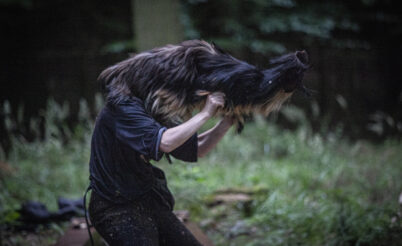
Those projects are actually about a guy failing – failing to embody or impersonate the animals. In the shows we don’t see images of the animals, and I never looked at images. We just have a name, and I imagine the animal. Because there are so many, the task becomes impossible. Looking at the list of extinct animals, I found the names strange, often poetic – sometimes funny – almost narrative. I felt I could make a show out of names. Vigil starts quite funny and then drops into a tragic space. For me, the best way to take people to a reflective space about extinction is to find an enjoyable way in – laughter first, then sadness. We have to laugh at the absurdity.
“Impersonating” is an anthropocentric notion – it recalls mimesis, theatrical imitation, which is often avoided in contemporary dance. Is that your way of tuning in, of getting in touch? You had a list of 26,000 names – you imagined the creature behind each name and tried to embody it. How did that work?
Embodiment… a lot of improvisation and play. I take a name, feel my way into it, see where it takes my imagination. For many names I’ve no idea what the creature is – I’ve never seen it. It’s trying to be mimetic without being able to see – an impossible act – but more interesting to imitate the animal we don’t know than one we do.
Did you know at least what kind of species it was – plant, bird, insect, or mammal?
Sometimes yes, sometimes no. The fun is when we’ve no clue.
The name is the only thing left – the symbolic relic, given by homo sapiens. You go down a path that’s impossible to reconstruct back.
Yes. The human on stage becomes more and more stupid – fails more and more – because he can’t do it. The human becomes small; the theme of the animals becomes big. It’s a Samuel Beckett approach – a theatre of failure.
So that was your feeling – a body-wisdom that you are small compared to the vastness, the list, the names, the symbols.
That’s where I arrived.
You read 26,000 names – you embody them at once?
No – they come as a very fast list.

Forest in a Black Box, Becoming Invisible
But it’s just a word. A few characters containing a vastness you can’t otherwise grasp… You use tragedy and embodied theatre. You also work in black boxes. When should a piece go to the black box, and when to the forest? How do you bring the black box to the forest and the forest to the black box?
They’re really different. In the forest I expand time – I slow down. An essence of the poetry of the movement remains, but the piece stretches into a slower space: no lights, no sound, just a human body. In the studio, I like bringing the outdoors indoors. The studio provides focus for a very small part of nature. In the UK, outdoor arts often means something big on a high street – clowns, circus – so quiet, small landscape theatre ‘for trees’ doesn’t exist yet. Maybe that’s a future space.
Can you give me examples where you’ve changed the place or the concept – something originally planned outdoors that later moved indoors? Here at KoresponDance, we’re also moving outdoor performances indoors now, sometimes because of the weather rather than artistic choice.
I’ve just finished a tour in Scandinavia: two shows for humans and one for trees – same show. Sweden for humans, Norway for trees, Denmark for humans, last month. The essence of the body’s poetic movement remained, but time, light, sound, and dramatic order changed radically. Performing in “tree time” – I’m still exploring that. You find truths you’d never find with a human audience. Trees are a very true audience for that show. I found things I wouldn’t have otherwise.”
Because you feel fully accepted as a part of nature?
Accepted, but also invisible. It’s strange.
Strange and absurd to perform for trees – and that very absurdity reveals the vulnerability of any human effort. You can’t get beyond being human; the more you become human – because you can never be anything else (?) – the more the piece moves you.
I think so. In theatre history it’s absurd, yes. But outside theatre, people have done rituals in nature for as long as we know. I felt I was doing something similar – a ritual to something bigger than me. I did it in the middle of the night in a Norwegian forest – you become very aware of being human: “Shit… The trees… you start to…”
“You really have to argue to make green touring possible in a world used to fast travel and flying. … Train travel – going slow for two days – is expensive and can frustrate festivals.”
Green Touring, Extinct Genres
It’s also like religious art made for God’s eyes – in cathedrals, unseen by people. Then, at some point, the priest turned towards the parish. Speaking of another kind of faith – in sustainability – within Green Streets of Europe, did you discover any tools or best practices you could recommend, a sort of toolkit?
Not so much a practical toolkit. What I learned is you really have to argue to make green touring possible in a world used to fast travel and flying. We’re making tiny steps. Train travel – going slow for two days – is expensive and can frustrate festivals. It needs a budget; the artist spends time on trains. I went to Portugal twice – three days each time – needing accommodation and food.
For me, green touring is a chance to really connect with nature and go on an artistic journey. As a nature artist I’m most inspired by landscape. Travelling through Norway, I was exposed to incredible geography, geology, sea, woods. That long journey teaches things no workshop can. I’m lucky – not everyone can do it. I travelled for two months over 1,600 kilometres, and I’m still benefiting.
Genres like Broadway or the West End – large-scale theatrical productions – are they a species bound for extinction because they’re not ecological? Do you ever engage with Broadway or West End–style work, given the ecological cost? Editor’s note: Read also choreographer Petra Fornayová’s reflections on ecological art and the paradox of responsibility.
I don’t – I never have. I’m sure some productions are very good and people like them. From an ecological perspective, they’re bad. The climate discourse now feels split. One group says we must change – capitalism, society – become green. The other – the Donald Trump’s right-wing crowd – says, “We don’t give a fuck. We won’t change. We’ll do more growth, more capitalism.” Broadway or West End sits in that mode – blind to the planet. We’re all still living in it.
However much we try, we’re conditioned by privileged first-world life: we buy stuff flown in from everywhere. Extracting yourself from that is a life’s work. We have our green recycling schemes – part of me says they’re necessary; part of me says it’s bullshit. It still ends up in landfill. If you go to China or India you see the scale of waste. Does it matter if I recycle this cup? If I don’t take that flight? Maybe it’s defeatist; maybe it’s realist. We have an illusion about agency, but we also have to believe in our agency to change things. I have conflicting thoughts – no right answer.
A closing question – back to technology. Do you think technology, including AI, can help us address climate change? Are you a techno-optimist?
In a way technology actually frames the climate question. Our understanding of climate change exists because of machines and their ability to forecast. I try not to have a response to “will tech save us”. I want to live in the now. The climate discourse has been with us for decades under the worry of what will happen. Maybe tech will help. Maybe governments will govern well. Maybe it’ll go apocalyptically wrong. Maybe it’ll be okay. We don’t know. I’m fed up with imagining what will happen – that’s my way of surviving mentally as an artist in a time of uncertainty. Others can forecast; I’m not saying it’s unnecessary – I’m just not going to do it.
Art is also a way to imagine the future – or things that are not yet present.
Yes, but the future is just a reflection of the present.
Tom Bailey is a Bristol-based theatre-maker and artistic director of Mechanimal, creating award-winning, body-led performances about life on a changing planet. His work merges physical theatre, sound, and visual design with ecological and scientific research, exploring how art can respond to environmental loss and transformation. In pieces such as Vigil, which attempts to “perform” 26,000 endangered species within an hour, Bailey combines poetic absurdity with urgent reflection. Trained in literature, activism, and at the London International School of Performing Arts, he develops an embodied, immersive practice rooted in sustainability and the interconnectedness of all living things.