Sue Schroeder: on Water, Time, Noticing, Czech Roots and Much More
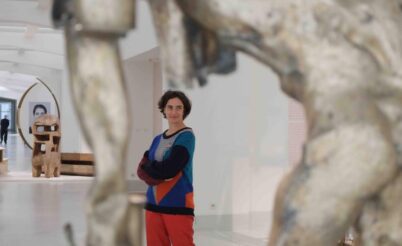
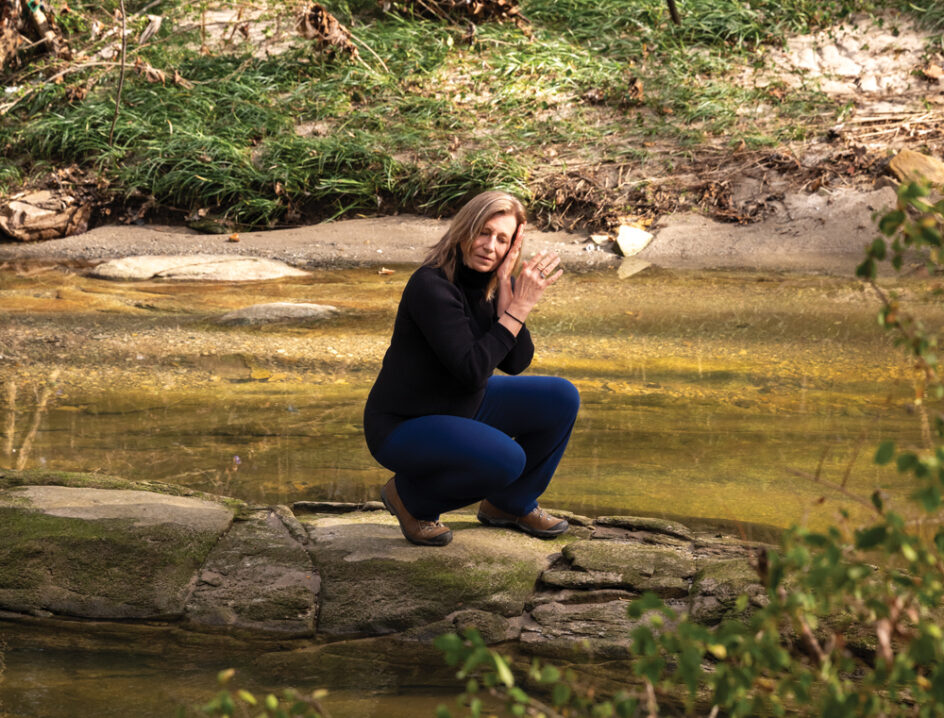
We met with Sue Schröder, an American choreographer with Czech and German roots who has been collaborating with the SE.S.TA Centre for Contemporary Development in recent years, during her several-day spring residency at Žďár Castle. There, she launched an artistic-participatory project on the theme of water and memory, Braiding Time, Memory and Water. After the opening day, during which she met with locals interested in the project and engaged them in various creative activities, I met with Sue to learn about her methodology, her artistic and non-artistic goals, her sources of inspiration, and her roots – both family and professional. To make it clear what we were talking about, I’ll recap what was actually happening.
Sue Schroeder: O vodě, čase, vnímání, českých kořenech a mnohém dalším
🇬🇧 READ IN CZECH | Se Sue Schröder, americkou choreografkou s českými a německými kořeny, která v posledních letech spolupracuje s Centrem choreografického rozvoje SE.S.TA, jsme se setkaly během jejího několikadenního pobytu na jaře na zámku Žďár. Zahájila tam umělecko-participativní projekt na téma vody a paměti, adaptaci svého projektu Braiding Time, Memory and Water. Po úvodním dni, během kterého se setkala s místními obyvateli, kteří se o projekt zajímají, a zapojila je do různých tvůrčích aktivit, jsme se sešly, abych se dozvěděla více o její metodologii, uměleckých i ne-uměleckých cílech, zdrojích inspirace a jejích kořenech – jak rodinných, tak profesních. Aby bylo jasné, o čem jsme spolu mluvily, shrnu, co se ten první den vlastně dělo.
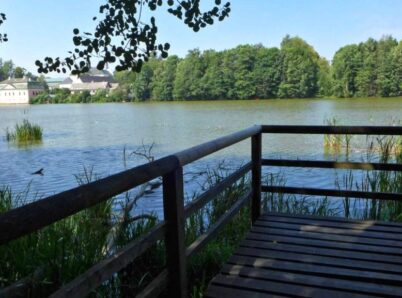
The foundation was communication with nature – more precisely, with a watercourse – and playing with the perception of time. We were supposed to – metaphorically or metaphysically, depending on who is capable of immersing themselves in which plane – attempt to address nature, ask for its support in creating the performance, and leave it a gift in the form of miniature altars or offerings made from natural materials. We also drew and gave our experiences colour and direction. To be honest, at that moment I saw no method in it at all, and I had the feeling that we were doing something both childish and, on the other hand, pointless. Does a person really need someone to teach them a ritual just to find peace in nature? (I have to admit that I always have these sabotaging thoughts whenever I’m supposed to take part in a performance outdoors, because for me, being in nature is an integral part of life, and everything else is just a distraction. And I also hate group games. And collectives in general. And rules. When someone else makes them. I’ve been honing my techniques for avoiding participatory activities to perfection over the years… Poor artists.)
That’s why, rather than focusing on theoretical foundations, I focused on Sue’s specific intentions to figure out what she hopes to achieve through her actions. The dance films she showed us were also helpful; one documentary captures a project she will recreate here (tailored to the landscape and the river’s flow). Our conversation is long, but I’ll try to present it to you in its entirety so that you, too, can immerse yourselves in the process. I must apologize for my scepticism, because everything that happened truly had a reason.
Let’s start with an overview of your collaboration with Marie Kinsky and SE.S.TA. How did it start and develop?
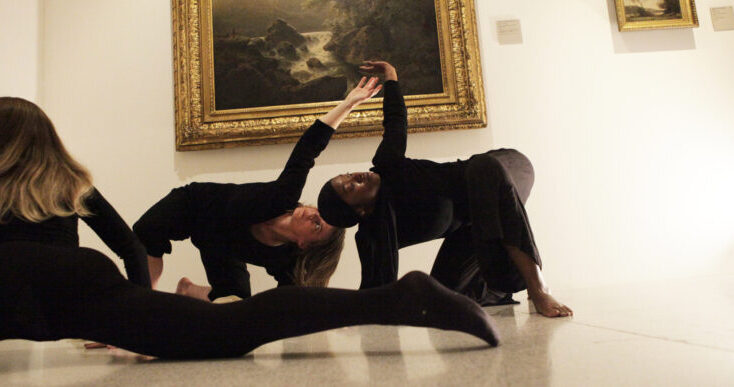
Marie and I met at a dance platform in Jerusalem. It was a beautiful gathering of maybe 80 artists from all over the world focused on contemporary dance. We connected because we had a strong point of view on process. I remember we made contact just across the room, and then found ourselves talking over several breakfasts and riding the buses together. While traveling to different places to see performances and reflecting on them, we found out how much we had in common. What Marie was curious about at the time was my coaching practice – the fieldwork – and my work in museums and gallery spaces. My first invitation to Prague was to do a project in the National Gallery. I started a few years later, toured the exhibitions, met with the curators, and we chose one exhibition that was then cancelled. So, I did research in their permanent collections and ended up on the top floor of the Trade Fair Palace.
The SE.S.TA series Dance in the Gallery is ongoing and many performances still happen in this space. How did you contribute to it?
I spent a lot of time in that collection, and then I had a group of artists I worked with in Atlanta. We brought five of them together with five local artists in Prague (Eva Urbanová, Barbora Látalová, Zden Brungot Svíteková, Johana Pocková and Roman Zotov-Mikshin; ed. note) to form a group, ready to start, but the Covid pandemic broke it up. I did all the coaching online for the participating choreographers and then in the summer we did a live stream. It was the US and Prague talking to each other. We had live events in both spaces where people could watch what was happening in the other city live. (The project was called Galleries without Borders; visual and video artist Ian Biscoe, who is associated with the Czech art scene, handled the technical production; Ed. note:) It was pretty wild. And then, eventually, after Covid, we did it live in the gallery and I did another coaching for Czech artists. We’ve stayed in touch and, for example, Bára Látalová has been in the original cast of Braiding Time, Memory and Water.
I see, I recognized her in the film footage you showed us. Is this how your water project was introduced to Marie?
I had a commission from Flux Projects in Atlanta to create Braiding Time, Memory and Water by the river that runs through the city; it was in October of 2024. Later I reoriented the work in a new location in April of 2025 and it was Bára who then introduced the project to Marie, I think.
Observing nature, river – and people
Here in Žďár, will this be a revival – a re-staging of an existing performance – or a brand new production? Can you explain how the Czech version will relate to the American original?
I don’t think it’s “brand new”, because as an artist, you take what you know from any previous work to the next one. I would say it’s a re-creation because it’s so much about the place. There are also plans to do this work in Gdańsk in Poland; I’ve already been there to research the rivers. I’ve worked in Gdańsk a fair amount, so I know people there, therefore I did not work with the community like here in Czechia, but studied the land (when I was there in October). It’s really important. All these rivers, the water of the world is connected, and all these places need attention. To bring this understanding of how important the water and the rivers are is crucial, but the underneath is important as well. “Water is life” says everyone, but what the river means in a specific location is very different!
For instance, I did the first one in Atlanta at Powers Island and the second one at a place called Tannard Creek. It’s the same river, but at the second location, which was chosen by the authorities, when I arrived, I found out it was actually a massacre site from the Civil War. And I was like, “What am I going to do now?” In such context I can’t just put my work here. I have to look at what happened on the land here and it really changes the work. I have to understand the place; that’s what this is really about – understanding the place, the water here, the people here, what the river has meant to them. I’m just cracking the surface.
In June when I come again to Žďár, I’ll be here for 10 days. Three days later, three dance artists will gather to work on the material. As you have seen yesterday, at the beginning we’re with a group, meeting people and connecting to them, which will continue. When I come back, I’ll be able to go in more quickly; it’s more about one-to-one conversations. Some people already start to see how this project and work can support what needs to happen here.
So, this work with “ordinary” people is part of the research?
Yes, 100%. Because who do we do it for, and why? You know, it’s a learning exchange. I need to learn from the people here. I’m challenged a little bit, and I’ve been thinking about it overnight, how to overcome the fact that I don’t speak Czech… I have to figure this out. There are many things I can feel in my body, but when you want to understand specifics, you need to talk to people. There’s a couple of scientists in the room and I spoke with one of them for a while and the conversation was fine. We were able to go deeper into what the science of this place is. I’ll also do my own research, in books, etc.
It’s nice to see someone from the dance field recognizing language as an important tool because many dancers insist that everything is only about feelings and the exchange of emotions. But I still feel that the fields are different. And for every occasion and every work, we need some different means of communication. If movement was enough, language would not have developed at all. Though art communicates – in many different ways.
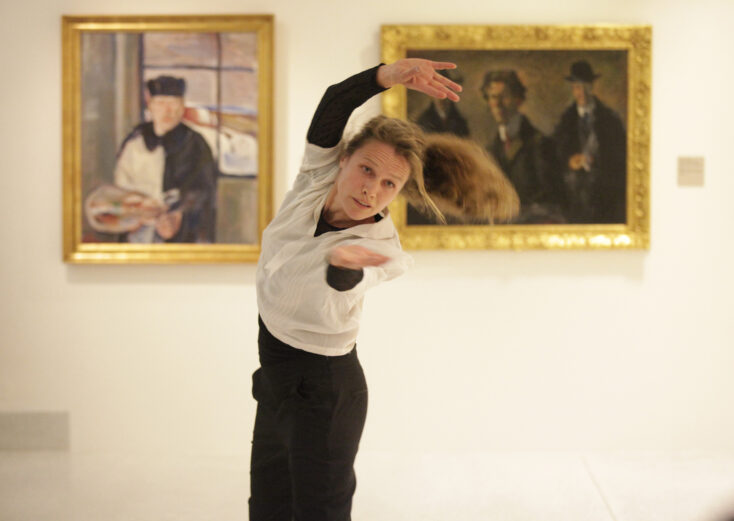
That reminds me of the work in the gallery. I don’t go into a museum or look at a piece of art and go directly to, “Oh, it makes me feel like moving this way.” I look at the art, I study the painter or the visual artist, I try to understand where this piece lives in their world, what was happening at the time of creation, if it’s a larger exhibition… Only then can we embody the actual work. You can see the movement through time. And curators, when they see it, are like, “I didn’t see that painting like that before.” You know, you create a different entry point. And that’s what this is as well: this is an entry into the place of nature that some people have (like you), but some people do not. And if we don’t love it, we can’t take care of it, and we can’t have the conversations. I also think we’re creating a bridge for regular people to the art.
So, to sum it up: the purpose of walking by the stream, making an offering to nature, and drawing was actually to include you, to honour this place. Based on our conversations about our impressions and feelings, we begin to understand what kind of relationship the people of this part of Žďár have with the river. And this will deepen as you study the history of this landscape, talk to the professionals who care for it, and so on, thereby creating the framework for the work that will emerge. What will the next steps be?
So, in June, we’ll do the 10-day research. And then the next June, the fully realized encounter will take place, whatever it becomes here. I expect that for that we will probably be here another 10 days or longer.
Will people from the community be involved in the piece itself?
From the moment when the experience happens, they are part of the event. I don’t know how it will “live” here, but right now, it’s composed of three parts, elements that can expand or shrink. They’re like scores; they breathe, depending on the location but also what the river says for time. The combination is also flexible. So far they went in the same order twice, but maybe it will not go as 1–2–3, but 3–2–2–1–3, whatever. It can be moved.
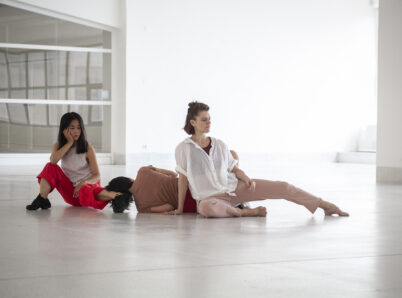
As it exists now, in part 1, the audience is a witness, experiences the work as it unfolds. In part 2, they are inside it, in the sense that they are part of the design of the space. As you saw in the film (the part on the bridge), the artists are very close to the audience. This was in a public space, so we had people just passing through and it was fine. In part 3, we make sure people are actually active. They’re playing instruments, and what we did before – I don’t know if it will happen here – is prior to the whole thing, there is a day where you can have activities like walks and meditation in nature and make sound instruments. So, people already had instruments they made that they brought to the performance. This way we keep getting people inside the work.
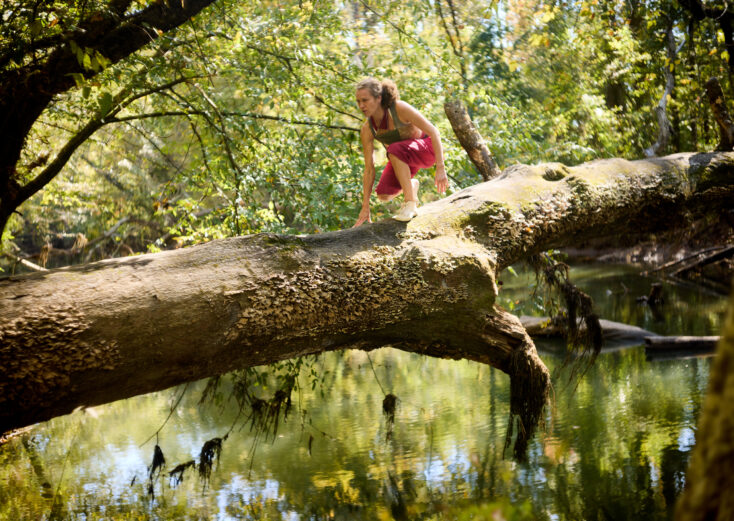
How to break the ice with a Czech audience
As I understand, you were born American. Why did your grandparents flee Czechoslovakia? Was it because of the communist regime?
No, it was before World War I.
Oh, this wave from the end of the 19th century…
My grandfather came over first, while my grandmother was pregnant.
So they were already a married couple?
Yeah. She travelled with the first baby by herself on a boat. And somehow, they found each other. It’s just amazing that they were so adventurous; they left their whole family and never went back. My dad then fought in World War II as a young man. My mother’s parents were Czech, my father’s were German. My mother’s parents, my grandparents, didn’t speak English, so we learned a bit of Czech. My mother was very clear she wanted to go back and find her relatives. So we came many times and met everybody on both sides of the family. How much of a traveller my grandparents were! I think that has affected me, that courage to just go. They went for a new life, for sure; it’s just fascinating that they made this choice. There’s that spirit somewhere in my DNA of this adventure.
Do you feel like you have roots in the Czech Republic?
Yeah. The strange thing is I had a long career over in Europe but without managing to get to the Czech Republic. Over the years, I’ve travelled here, but had no work here ever. And then it was just so unexpected to meet Marie Kinsky and go, „Oh, wow. Now it’s happening,“ to now being here somewhat regularly. It’s very special that it happened now in this part of my life that I have this work here.
How do you actually feel about Czech people as an audience and as participants? Like, are they into participation, or are they rather reserved?
My family’s roots are here in Moravia. I have been here many times to see the family relatives, so it feels different for me. But what I keep hearing (and I’ve also worked in Poland a fair amount and experienced it) is that people from Middle and Eastern Europe with a communist past are a little more hesitant. I am aware, but I just remain open to the human nature of it. And so far, I haven’t seen it as a rule that people would push back. With the group yesterday, we had young girls that said they were nervous but were leaving feeling fine. So, it just takes time. And I feel that if I make myself open and available and don’t run it as a hierarchy, it works. Last night, Eva Dryjová said to me, “You know, you Americans always ask permission; you try to do the right thing. I wonder if you could be more direct with how you want it to go.” And that’s not for me. I ask myself, how can I pay attention, what does our work together look like? Working together looks different in different cultures. Being alert to listen to the others is crucial.
So, you’ve worked with water for 10 years or so. How did this interest of yours start?
I was raised pretty much in nature. I love the sea, the oceans. As I grew into a young adult, I spent a lot of time by the sea. In the United States, there are two organizations dedicated to celebrating and advocating for water; one is National Water Dance, and another is Global Water Dances. National Water Dance happens every other year on Earth Day weekend. It’s a group that organizes events all over the US on the same day at the same time. There are performances near water to bring attention to it, and they have a very particular point of view. And then on the other year, Global Water Dances organize their events. Last year I coached Bára Látalová for her Global Water Dances performance.
I think I’ve heard about the project.
I’ve been involved with these projects for a long time. It gave me a larger context to work in and then also to coach other choreographers and makers. That deepened my interest. Once I started doing that, which were very particular times, the work started to arrive at the point where people had more questions and wanted to see it in their village or their town. I also worked with environmentalists and, as I mentioned yesterday, there is a group of lawyers who are working on giving nature its legal rights (the Rights of Nature Movement). The Global and National Water Dance were mostly art-based, but they were having difficulty connecting to scientists and activists, so then I brought these groups together. People said, “Do you know you’re a person that connects people?” And I think that’s a piece of what I do here because it’s bigger than me.
It’s similar to Marie Kinsky’s work; she also aims to connect people from different backgrounds and practices that no one would think about connecting.
Yeah. And that’s how we get along; I think we see that in each other, and we inspire each other. She does it in a very different way, but we have this in common. But did I answer your question?
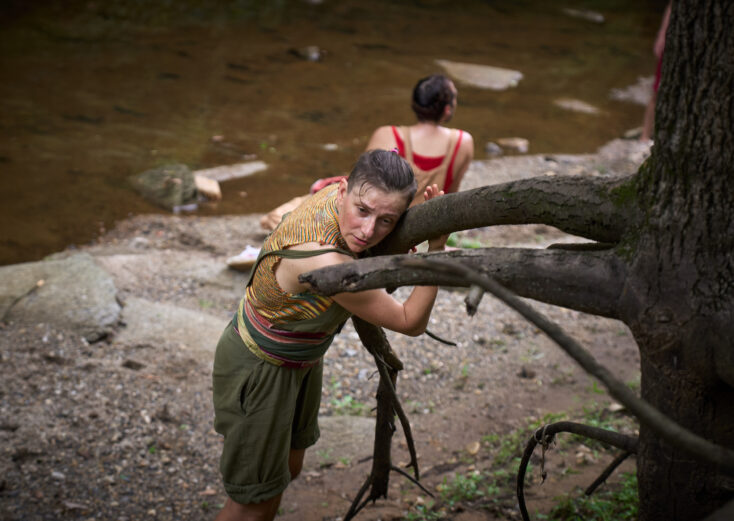
Activism and care
It’s not just about questions and answers but about getting to interesting thoughts. I have another thing on my mind: when you introduced yourself, you mentioned activism. What was your relation to activism throughout your life?
Of course, when I was very young I liked that radical approach, “Let’s fight for nature! Let’s do this!” But, after some experiences, I felt everything was more about understanding and about care and about caring for nature.
Can an artist be an activist and a caregiver at the same time? Are these things connected?
Yeah. Well, I think it depends. I’ve been an activist for a long time, been on the streets to protest and to protect many things, not just nature. I think it both evolves in time according to where I am in my life. I mean, I started all of this in my 20s. Now I am close to 70. So I’ve done all these things for some time, and now I spend my energy in a different way. But I think there are just different ways to make a difference. Now I feel you need all kinds of aspects of activism. You need to see it on the street, so people know that there’s energy that they can get involved in. But the care is part of it, because it’s a long road. “It’s a long game,” they say. It’s like you put it all into this, and you’re depleted. That doesn’t help anybody.
What I’m interested in now is this kind of activism that is more outside-looking, you know, seeing and… When you’re marching in a protest, it’s about getting attention to the problem and you feel like, “Wow. I’m with a group, and we believe the same things, we are connected,“ but what happens after that? For me, it’s one small group change at a time. Relationships are potent. If I can speak with you or create, through experiencing the creation you’re going to be changed inside. Let’s see what happens in your day, who you’re with, who you also share it with, maybe you will take somebody out to nature. I don’t know what people will do with what we did yesterday, how much it will matter or if it just mattered to the river. I don’t know. But I feel like it matters.
I have two grown kids, 31 and 26. When we say “We want world peace”, firstly we have to have peace in our home, peace with one another, then peace with the neighbour next door, then peace with the person that passed on the street. And then we can go out. This is activism from inside and care is part of it. If you feel attacked by activism, you resist. A strong part of my coaching method is to ask questions. You don’t ask questions that are combative, like, „Why did you do that?”. It’s something we’ve called a neutral question, to say: “I had an experience about this when I watched your work, or when I had this conversation with you. Can you help me understand what you meant?” Then we can create dialogue. And it may not always be speaking, but it is an exchange.
So, should art always bring some change?
In my mind, yes. But there are makers who don’t feel it this way and it is up to them. But from my point of view, that’s what I’m curious about, that’s the kind of work I follow. When I think about the dance platform in Jerusalem where I met Marie, there were 80 of us with this spirit in the contemporary dance world. And at the same time there’s a gathering in Tel Aviv, more of a dance market of Israel. And the dance is stunning. The programme goes from 10:00 in the morning till 10:00 at night, in three or four theatres, and you just keep watching dance and dance and dance. The dancers are beautifully trained, they’re gorgeous to watch. But after two days, I started to ask: “Okay. But what does it mean? What does it matter? It’s all gorgeous but what do I do with that?“ By the end, I found the work that was curious to me. There were five artists that I brought to the States; they had something more than beautiful dance. Beauty is important but there must be something more. In the film you watched, beauty was important, but that wasn’t all of it. You can communicate through beauty a secondary idea. That’s interesting for me.
Pro mě je zásadní, když se ve společenství odehrává jedna malá změna za druhou. Vztahy jsou silné. Pokud s vámi mohu mluvit nebo tvořit, prostřednictvím prožitku tvorby se změníte zevnitř.
Leading the performers
And when you work with dancers, do you create the choreographies set for them, or is it their own material that you just shape or direct somehow?
Now it’s closer to the second. I almost died in a car accident in 2011. I couldn’t dance or hardly move for six years. During that period, I had to do much more coaching, where I encouraged dancers to create this way where we’d start improvisationally, some material would form, and then I would start to mix and match and roll, you know, take people’s work and mix it and grow. But even before I had the accident, it was never intended for them to take my work and reproduce it exactly. Rather my phrase work would start an idea, and then we would grow it from there. But then when I couldn’t move, it became more of calling the movement out of them. Now in nature, it’s almost providing a… what would I say? It’s always about creating a place where art can arrive. And then I’m constantly working with what’s in the room to pull it out.
Is the dialogue with nature, with water, with anything outside more a metaphor for you, or do you really believe that you actually talk to nature?
I think it’s both, but I definitely think the second. I follow a US-based organization, Bioneers. They follow the work of scientists who are able to capture the actual communication with nature and how it’s speaking. There are botanists that research how plants are responding to their environment; the generosity in certain plants is incredible. Science is beginning to actually document what some of us have always felt, so I follow this kind of science too. And metaphors are beautiful. For me as a maker, it’s not my point that you believe what I believe. But what is important, I must enter the creation of my work very true. It’s not ego. It’s listening and saying, „What do I have to say now that matters and can make this move forward?“ It could just be beauty. There are so many people that don’t have beauty in their life. If I can create a moment of beauty, I’ll do it.
Anyway, how do people define beauty? I think the shadow this chair is making right there is exquisite. I notice it. But somebody else really might need more of a typical beauty, which is fine. So, as long as I can make my work from a true place, then it opens an experience for more people to enter. You said you spent a lot of time out in the forest, in nature as a child, so you entered yesterday in a very particular way. Someone who had never been there had a different experience. So, in contemporary art, particularly if you want to be engaged with it, it requires that you make something that is “pure”, that all people can find their way into something there. There’s something for everybody, even if it’s just a tiny moment.
Pro mě jako tvůrce není důležité, abyste věřili tomu, čemu věřím já. Důležité je, abych do tvorby svého díla vstupovala s naprostou upřímností. (...)
Zkušenost mi říká, že mnoho lidí prochází životem, aniž by si toho všimli. Buď vzpomínají na minulost, nebo myslí na budoucnost. A uniká jim možnost vidět nádherné věci kolem sebe.
The presence and play with time
The instructions for us to take care of what catches our interest or how we feel, is it to help us find the beauty in nature and find the special connection to nature? Is it a way to make people more aware of where they even are?
I don’t know if it’s about “making them” because it has to come from inside; you can’t make a person do anything. But my experience tells me that many people go through life not noticing it. They’re either thinking back or thinking forward. And they’re missing the possibility to see the gorgeous things around them. For example, people who say in disgust, „Ugh, it’s raining again,“ miss the beauty in the rain. It’s raining and you’re not going to do anything about it. So, be present with the rain, with the sound, with the drops. Yesterday it was about noticing. Perhaps noticing in nature allows you to notice in your life, not only in nature. It’s so much to notice; there are experiences everywhere. So I think it’s about life, aliveness, and the body.
The strange thing was that we were able to be present in nature but so close to the town with its houses as well. It was a bit disturbing, as someone else also made a remark about this, but despite it, he was able to enjoy the nature.
It’s good to know that you can do that. You have that possibility. Also, one of the guests said: „I did this as a child, and I loved it. Why don’t I do it more?“
I think her remark was about all the activities, not just walking in nature but also playing with the small stuff and building the offerings, these things. I think she was referring to these more than the presence outside itself. Children play with branches and grass; we do not do that anymore.
I know people who every morning make a so-called “morning altar”. They go find leaves and flowers and make a little picture out of it. That’s their form of meditation, to take this moment. It’s about spending a few minutes starting or finishing the day. These tools are access to something more in our lives.
Another important thing was the concept of time. I think we didn’t quite understand the excerpt of the book because it’s hard to translate, and what the instructions actually were. But I think it didn’t matter because everyone found their own time.
And that’s really the point. We have time of the clock, Kronos/Chronos, and then we have Kairos. It’s like when you think about how a minute can last an hour and an hour can last a minute. How does that happen? You know, your experience of time in relation to the clock can be very different depending on how you sense time and what’s happening. So, that was really the point. For me, to have that read or put out in there is just the possibility for anybody. It worked for the woman who was sitting next to me at the end of the afternoon who was talking about Mexico… If one person is touched, it’s fine. And it’s always putting out one more way to consider. I think with education, there’s not one way to learn. You keep offering possibilities and it matters to somebody. It’s about opening up to time. Time functions differently for all of us. So, maybe people didn’t understand it, maybe it didn’t make sense. But then you are at the river, and something unfolds. You get a different sense of time.
And the time somehow changed because you made the frame for it to happen.
Exactly. And that’s how I operate in rehearsal; I create the frame for something to appear, which sounds like I’m doing nothing, but I’m doing much behind and around, watching and observing and adapting and noticing. I had a German teacher in graduate school who said to me, „You come in with a plan, but the best teacher comes in ready to change the plan. Have a plan, but don’t hold on to it just because you have it. Be ready to let it go because something will appear.”
And all these exercises you use, is it your method or methods you learned and now apply in a new practice?
I think it’s a “soup” of ideas and methods. When I studied, Anna Halprin was one of my teachers. I’ve worked with her at her home and her mountain studio. She was a very good friend and affected me deeply. And it came at a time when I was already doing this kind of work. In my dance world, there weren’t so many of us that I had relationships in this way. I was also around a lot of visual artists, which she was too. Now I’m around a lot of improvisational musicians, with a community of musicians that are working the same way with music – I’m working with improvisation and movement. We have these deep conversations that just keep it super alive.
Anna was also very much committed to nature, although she also worked in a theatre. She had a very strong influence on me in the last 10 or 12 years. I’m now really good friends with her daughter Daria. I was already doing my healing practice work when we met, which is very aligned to what her Tamalpa Life/Art Process® practice is. When I found she is involved in it, I felt we were alongside each other. I wanted to start the training there and Daria was like, „You’ve been doing this a long time already. Maybe we do the training another way.“ So, we have these really deep conversations where I take notice of the training and understand how they do it and what makes sense of it for my work. These multi-entrances with the life art practice at Tamalpa Institute, which is Anna‚s and Daria‚s work, is movement, visual art and writing, which I also do both in rehearsal and movement. They explore in the body. They explore in the text. And they explore in the visual art. I was happy to find someone with this approach. Anna was able to heal herself of cancer and found all these practices strengthened her. She probably worked with all those elements when she was making dances, but she really worked it in this healing art. And we found our tribe.
So, let’s stop at this point and continue later on when the creation starts with the performers. Thank you for sharing your thoughts and practices, and good luck.
Lucie Kocourková je novinářka, autorka literatury faktu, kritička, PR manažerka. Patnáct let praxe v oblasti taneční publicistiky – zpravodajství, recenze a rozhovory pro server Taneční aktuality.cz, dnes je editorkou a redaktorkou portálu Opera Plus, kde vede taneční sekci, publikuje v Divadelních novinách, na portálu Divadelní.net, ve Světě a divadle, Divadelní revui, na portálu Maomai a v dalších médiích. Je koordinátorkou aktivit Nadačního fondu a Institutu Pavla Šmoka. Od podzimu 2023 také znovu PR manažerkou (nejen) barokního orchestru Musica Florea.
lucie-kocourkova.cz
Note: Kronos and Kairos
The interview briefly mentions the framework of one of the exercises on the perception of time. It involves the application of ancient principles. “In ancient Greece, there were two words for time: chronos and kairos. Each aspect was represented by a different god. The god Kronos was depicted as an old man with a sickle in one hand, reaping all that is past, and a lamp in the other, illuminating the future. He thus represented time in its flow, rhythm, and sequence, as causes that produce their consequences. In contrast, the youth Kairos is a symbol of that fragile, almost elusive “now”; the present moment that will not be repeated, and which must therefore be captured, perceived, utilized, and transformed into experience so that it is not lost. Kronos is thus time in its quantity, as the words bequeathed to us by Greek ultimately demonstrate: a chronicle records events in their sequence, chronology arranges moments one after another as they followed one another, and a chronometer measures the seconds that pass one after another. Kairos, however, points to the quality of time; a characteristic that does not automatically belong to it, as minutes and hours pass, but which each person must bestow upon it themselves, for it will be different for everyone. Then Kairos will not be merely a fleeting moment, but a moment properly utilized, endowed with meaning, the art of being in the right place at the right time and doing the right thing. In English or French, therefore, the word kairos is still used today precisely as a synonym for the opportune moment.” (Source: https://www.akropolis.cz/content/kairos-buh-spravneho-okamziku)
Who is Lucie Kocourková?
Who is Lucie Kocourková?
A journalist, non-fiction author, critic, and PR manager.
With fifteen years of experience in dance journalism – including news reporting, reviews, and interviews for Taneční aktuality.cz – she is currently an editor and contributor for the Opera Plus portal, where she leads the dance section. She also publishes in Divadelní noviny, on the Divadelní.net portal, in Svět a divadlo, Divadelní revue, on the Maomai portal, and in other media.
She is the coordinator of activities for the Pavel Šmok Foundation and Institute.
Since the autumn of 2023, she has also been returning to her role as PR manager for (among others) the baroque orchestra Musica Florea.
lucie-kocourkova.cz
Core Dance/Sue Schroeder (USA) & Barbora Látalová (CZ), Katarína Brestovanská (SK), Katarzyna Pastuszak (PL): Water and Memory
25 June 2026 | KoresponDance | Žďár nad Sázavou
The Water and Memory project presents an encounter between art and ecology at KoresponDance. Through movement, sharing, and dialogue, it explores how creativity can connect people with the landscape, water, and responsibility for the world we live in together.
The project follows the City and Nature 2025 initiative. Once again, it deals with humanity’s relationship with nature, but this time focuses on a specific theme. Choreographer, mentor, and environmental activist Sue Schroeder, together with an international team of professional choreographers, will adapt her successful performance Braiding Time, Memory and Water to the Central European context, specifically for the Vysočina and Žďár regions. Join us in studying water from a geological perspective and exploring coexistence with water, together with residents of Žďár, students, educators, and regional experts.
Concept: Sue Schroeder in collaboration with conceptual artist Jonathon Keats and composer Felipe Pérez Santiago.
Performers for Žďár nad Sázavou: Barbora Látalová, Katarína Brestovanská, Katarzyna Pastuszak, along with Stuart and in collaboration with the Sázava River.
Involved communities: PLA Žďárské Vrchy, Sdružení Krajina, BIGY Eco-Club students, Polná Secondary Schools, Škola na Radosti, the Živý svět association, independent scientists and teachers, EDU Department at Zámek Žďár, Solektiv.at.
Support: The event is held with the support of the Interreg Austria – Czechia 2021–2027 Programme.

Sue Schroeder has created over 110 original dance works for theaters, museums, green spaces, architectural sites, and aquatic environments during her more than 40 years in the artistic sphere. She is recognized as a leading art activist, mentor, and founding artistic director of Core Dance. As a contemporary artist and choreographer, she focuses on the creative process, movement research, and the creation of dance as a catalyst for social change.
Katarína Brestovanská is a Slovak dancer and choreographer based in Bratislava. Her work combines contemporary dance with classical and experimental music. Since 2011, she has collaborated with artists and ensembles in Slovakia, Germany, and the Czech Republic. She is a co-founder of the En Vorentoe project, whose work DUAL won an award at the FINTDAZ festival in Chile. In her participatory projects, she focuses on themes of polarization, violence, and social relationships.
Barbora Látalová is a dancer, choreographer, and educator based in Prague. She is a co-founder and artistic director of the Ostružina association, which focuses on movement performances for young audiences. Her production Animal Carnival won two Czech Dance Platform awards and was presented at Internationale Tanzmesse NRW 2022. She studied at the Duncan Centre Conservatory, Hunter College in New York, and dance therapy at NYU. She has collaborated with the international theater company NIE as well as artists such as David Zambrano or Sue Schroeder. In 2025, she co-founded the Feet Forward festival.
Katarzyna Pastuszak is a dancer, choreographer, and artistic director of the Amareya Theatre & Guests ensemble. She works at the University of Gdańsk and connects artistic creation with research. Her work is dedicated to ecology, posthumanism, and performance art. She is the author of professional publications on Butoh, and her work has been presented in Europe, Asia, and America. Since 2019, she has collaborated with Sue Schroeder and Core Dance on international projects, including Braiding Time, Memory and Water.