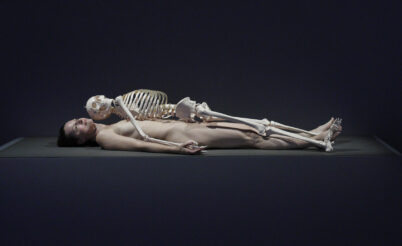
Pavla Beranová: A Rare Ray of Light
Can a museum be lit by daylight alone – and still capture “a rare ray of light"? What happens when light strikes a living body – why does a deer freeze in the headlights while a dancer comes alive? Why does a lighting designer who freezes like a deer in the headlights devote her life to light? With lighting designer Pavla Beranová, we discuss her book Light and Exhibition Space, and the both visible and unvisible impact of gallery or theatrical lighting. Pavla Beranová will also be presenting her book at the Talk Next discussion forum at the SE.S.TA's KoresponDance Festival in Žďár nad Sázavou (17–19 July 2026).
The Cave and the White Cube
Your book Light and Exhibition Space, published by the Janáček Academy of Performig Arts in Brno, opens with a quotation from Plato. It makes me think of the Platonic cave with its peculiar “lighting”. We see images as shadows, while the source of the light remains hidden behind a screen…
I would connect this with the theme of visual perception – what our eyes actually see and how our brains then process the image. These are precisely the points where the exact intersects with the inexact, forming a perspective on our existence, on our presence and on the surrounding world.
The images are being exhibited in the white cube of a gallery – which is really also a cave. Where did this concept come from?
The type of gallery space that Brian O’Doherty described in his famous series of essays Inside the White Cube from 1976 was not supposed to provide any commentary on the exhibited works, instead affording a completely “clean” space. It must be noted that those essays, which essentially introduced the term, are critical of it. O’Doherty actually argues that such a space is not in fact neutral. I recommend reading them.
Today we have moved quite far from the days of the radical “white cubes”. Exhibiting art is more contextual yet it still holds that contemporary art tends to be exhibited in general, ambient lighting. There are various reasons for this, some of which are practical. Exhibitions lit by accent lighting in a dark space tend to be found more in ethnographic or natural history museums, when displaying jewellery, the applied arts…
In the cave, we don’t know we are being deceived. In the white cube, we think we have rid ourselves of deception… It occurs to me that in the black box, light is the active source while in the white box it reflects passively off the white walls. Why is white considered more neutral than black?
I think ambient lighting in a white space is perceived as more neutral than accent lighting in a black one as it does not guide the human eye – it does not direct the gaze. Moreover, our evolutionarily rooted visual reference is daylight. A bright space that reflects soft, diffused light feels familiar to us, whereas objects lit with accent lighting in darkness do not – and they moreover evoke theatricality, which is in itself a cultural reference.
A Rare Ray of Light
We usually associate accent, or “theatrical”, lighting with artificial light. Yet can natural light be used to create a sense of focus as well?
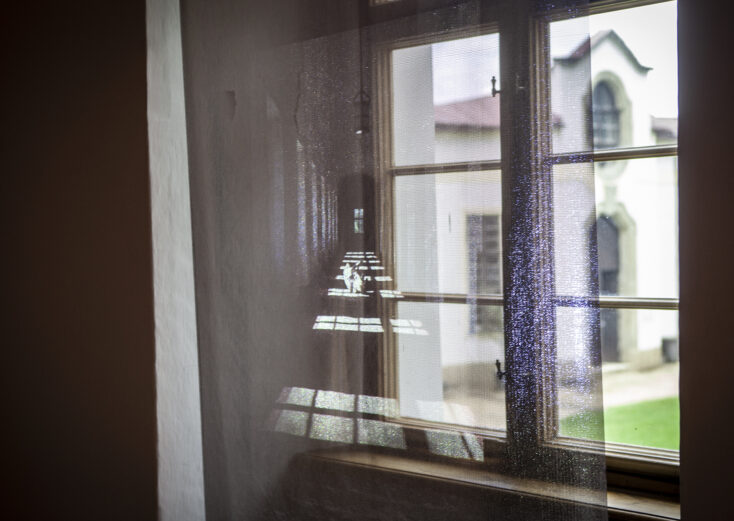
A text by the architect Jean Nouvel, which I quote in my book, comes to mind. He wrote about his conception of the Musée du Quai Branly in Paris, where objects from traditional cultures across all continents are preserved and presented. There, he works with daylight but filters and limits it in various ways so that it penetrates the exhibition only locally and is markedly heterogeneous. Among other things, he writes this: “Everything is designed here so that the emotions hidden in the objects are awakened – so that they are protected from the light, yet at the same time a rare ray of light is captured.”
The Musée du Quai Branly exhibits non-European art, and is therefore an example of what is called an ethnographic museum. You say that in such places the lighting tends to be accentuated, “theatrical”. Yet for European art we employ the white cube – what does this say about our approach to art?
There are several layers to this. There is the layer of “producing context”, against which the white cube originally defined itself. We mostly seek to create some visual context for ethnographic collections. Our Global North perspective is also problematic, as we regard the art and culture of other continents as something exotic and exhibit it accordingly. Yet this does not mean that we are exhibiting all those objects in the wrong context – it is the tendency to generalise that may be problematic.
There is also the “conservation perspective” layer. The objects in these collections are quite often made of materials very sensitive to light, such as leather, wood, feathers and fabrics, and therefore they must not be lit too intensely. Taken together, these factors contribute to the preference for darker exhibition environments. With contemporary art, for example, the illuminance-level standards are usually not so strict, and that is another reason why exhibitions of modern and contemporary art tend to be rather bright. The lighting concept applied is always a mix of various established principles, the requirements of the artists, the expectations of the visitors, and the actual needs of the exhibits.
The Light in Which the Work Was Created
Is natural light actually suitable for works of art?
There exists an opinion that works of art should be exhibited in lighting that approximates the conditions present at their creation. This is of course fairly difficult to do but makes some sense, for example, with paintings, because colours truly look different under different light. A good example – and a case where I personally consider natural light appropriate – is the works of the Impressionists. Apart from the fact that they painted a great deal en plein air, in those works there is something like a vibration of light, something almost tangible. And daylight, even when diffused, is constantly transforming. Hence I think it is, in this case, more suitable than static, neutral artificial light.
The first curator of the Impressionist collection at the Musée d’Orsay held the same view. When the building was being reconstructed as a museum, he succeeded in ensuring that the exhibition room is penetrated by natural light and its visible transformations. Likewise, the Water Lilies at the Musée de l’Orangerie are lit by natural light through an enormous skylight. I also recently saw Monet’s Water Lilies at the Fondation Beyeler in Basel – today they are installed in a room where relatively even natural light penetrates, but they were originally adjacent to an actual lily pond. In this part of the gallery, only a clear glass wall separates the exterior from the interior and, when the sun is very low, it reflects off the pond’s surface to fill the room with shimmering reflections. I can imagine that in such light the painting and the light fuse almost miraculously into one.
To Reveal and to Let Be Revealed
You move between exhibition-making and theatre. Is there anything from your experience with exhibitions that feeds into how you approach theatre?
It is rather the reverse. So far, I have not used direct experience from exhibition-making in theatre. Yet just today I was looking at an excerpt from Romeo Castellucci’s new production Pelléas et Mélisande at La Scala… He has vitrines there lit with typical accent exhibition lighting and golden jewels appear to levitate in them. When I think about it, in some performances I have created scenes that feel more like installations or exhibitions, and only then does dramatic action develop within them.
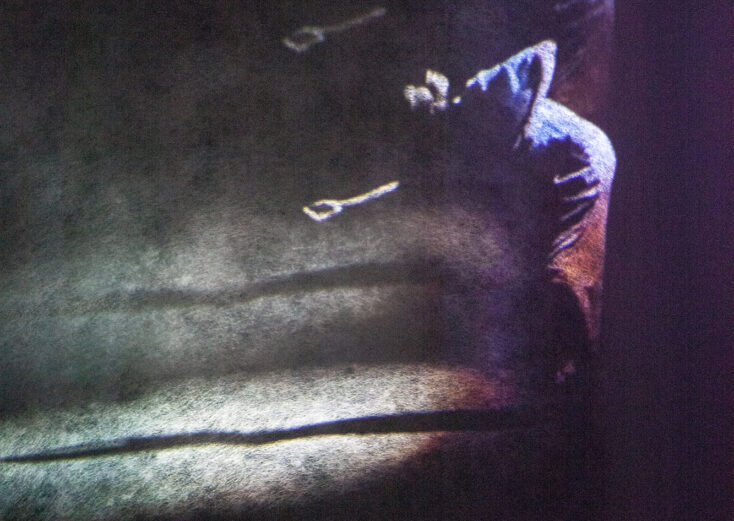
You say that certain scenes you’ve lit in theatre have had an installation-like quality. In Blurring it was first an installation in a chapel where you worked with the principle of apparition or revelation. That also interests me because we touched on it in a conversation I had with Denisa Musilová about the re-performance of Luminosity by Marina Abramović. What was happening there?
That was an installation for the SEFO Triennial in Olomouc. It was originally meant to be created at the Archdiocesan Museum, but when reconstruction work began there, the curator Bára Kundračíková and I had to find another space. Bára ultimately chose the Corpus Christi Chapel, which is part of the arts centre of Palacký University – this gave the work not only a greater scale but also a far more marked spiritual dimension.
From the beginning, the intention was to create a replica of an existing painting that would radiate light, and this light image was to be gradually blurred by layers of very thin Japanese paper. Viewed through all the layers, the scene would appear only as a cluster of coloured surfaces, but – as the viewer gradually approached – it would come into focus. For the original version I had chosen a sacred image of St John in a red robe, but the blurring effect made me associate it more as an accretion of layers of cultural development. We look at works from the 18th century with the eyes of people from the 21st century, and inevitably see something different – the original meaning and sometimes form have been displaced.
In the Corpus Christi Chapel, however, the altarpiece depicting the Supper at Emmaus became the central point, and the installation thereby acquired an additional dimension. The painting by Jan Kryštof Handke captures the moment when Jesus and two disciples sit down to supper after a journey they have partly made together, but the disciples do not recognise Jesus. They only understand who he is when he takes the bread and begins to break it. In that gesture he is revealed to them.
What role does light play there?
I used the light in such a way that it participated in that revelation. It gradually expanded from Christ’s hands to the disciples and throughout the painting, and then the area of light slowly diminished again and the focus “sharpened”. The only place that never went dark were the hands and the bread, meaning the blurring and sharpening ultimately functioned in both space and time.
A Deer in the Spotlight
The way Blurring’s light sharpens and blurs the scene is actually the process that creates the image. Yet when you need to illuminate a living body on a stage, how do you work with it? Do you model the anatomy or are you more interested in the silhouette?
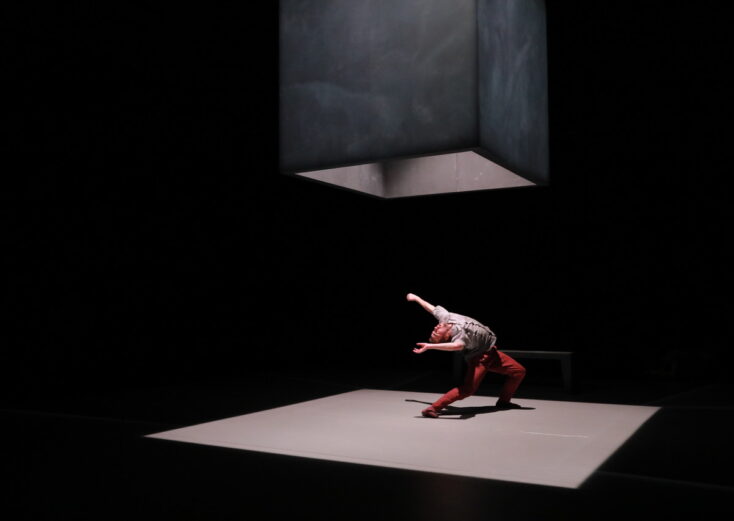
Perhaps one could say that certain movements work better in a certain kind of light, but it is more a question of timing. When the lighting changes – for example when a light is switched on of off – simultaneously with a movement, it tends to have a strong effect. When I began lighting dance, I operated the lights manually, without using pre-recorded sequences, to precisely follow the movement. This is something many of my colleagues do, for that matter, as it is only then that you are truly connected to the dancers and “dance with them”.
It is what needs to be “seen” at the given moment that always interests me. And I have to come to an agreement with the choreographer on what needs to be seen. That, incidentally, is precisely why light is so important for dance and other forms of live art. It shows what needs to be seen and conceals what should not. That is how image and narrative are built.
In our interview for Dance Context’s Taneční aktuality you say that light in visual culture tends to dazzle rather than enlighten or truly illuminate. In my mind’s eye I see a deer caught in a car’s headlights – and how it suddenly freezes into such an image.
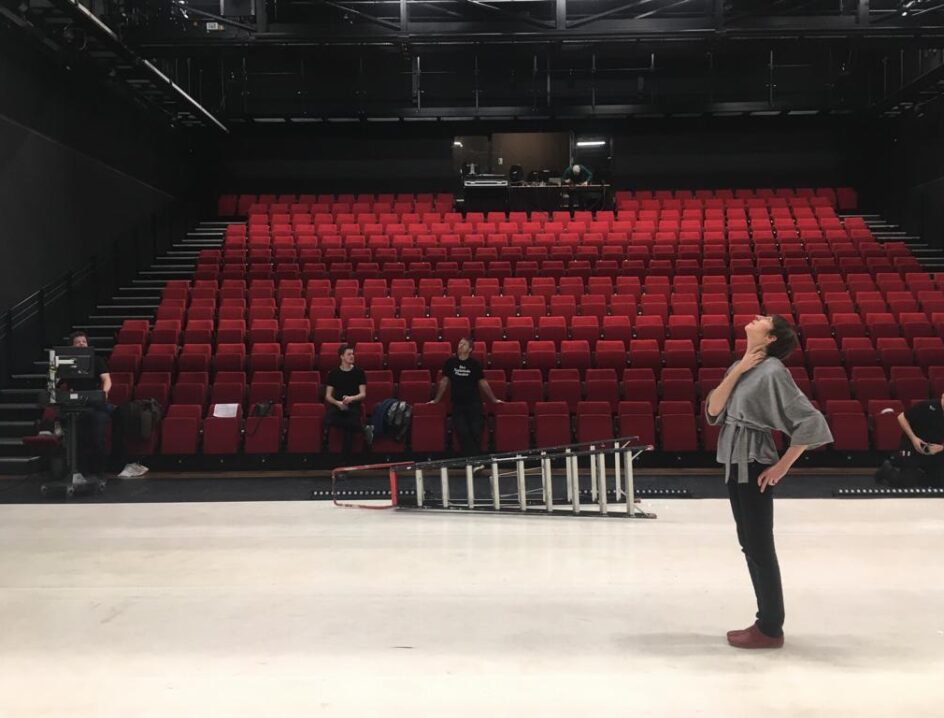
Except that the deer does not know it is becoming an image, and its participation is passive. The dancer’s is active: “The light is on me, I am seen, I am part of the image.” For many people this is extremely unpleasant – consider the common example of how you shine a light on someone in the audience and they are suddenly meant to participate, with everyone looking at them. I myself do not seek out the light either. Once I even fainted at a live performance – partly from the heat but also because I was visible in it. I am more the deer type: I freeze when the light is on me.
I have the feeling that, on the contrary, professional performers generally come alive when they are lit. Dancers, above all, perceive light and interact with it. Light also provides a certain type of connection between the audience and performers. I have met dancers and actors who like to see – or at least sense – part of the audience, as this helps them gauge their energy and emotions. I know from several people that when they perform, dance, or sing behind something, for example a gauze curtain, they feel they are playing to a wall.
Pavla Beranová is a lighting designer, artist and educator. She studied media studies and journalism at Masaryk University, and theory and history of design and new media at UMPRUM. During her studies, she worked in the lighting department at Archa Theatre and completed two internships in Paris that fundamentally influenced her professional direction: at C2RMF (Centre for Research and Restoration of Museums of France) under Jean-Jacques Ezrati, and at the Lumières Studio founded by Odile Soudant, focused on architectural lighting. She worked at the ACT Lighting Design studio in Brussels from 2011 to 2015, where she participated in lighting installations and large-scale stage productions. Together with Vladimír Burian, she led the Studio of Lighting Design at JAMU in Brno for several years. Today she creates lighting concepts for theatre, exhibition projects and architecture, while also teaching lighting design at DAMU in Prague. | Source: NAMU
Martin Maryška is a cultural manager, aesthetician, and DBT therapist-trainer. In his interdisciplinary practice, he brings together contemporary dance and psychology with visual art and graphic design; he is interested equally in the production of art and its aesthetic reflection. Alongside his long-standing focus on dance in gallery spaces, he has for many years studied visual dramaturgy in theatre posters. His doctoral research at the Department of Aesthetics, Faculty of Arts, Masaryk University (2021) focused on the theatricality and performativity of theatre, building on his earlier studies in aesthetics at the Faculty of Arts, Masaryk University (2009) and in theatre management at JAMU (2008).
At the Centre for Choreographic Development SE.S.TA (since 2020), he leads the Dance in the Gallery cycle, as well as activities in theoretical reflection, including editing the online journal Blog SE.S.TA. Alongside his work in the arts, he practices dialectical behaviour therapy at the National Institute of Mental Health. He publishes essays on the relationship between contemporary dance and visual art in Taneční zóna.
Talk Next
Books in Practice, Questions in Motion
At KoresponDance 2026, Talk Next is a discussion-based format that brings together authors from architecture, lighting design, dance and new circus. Guided by shared curiosity, it opens their books through practice and discussion, creating a space for exchange with both professional and general audiences. Talk Next is also part of the emerging Hub 800 Library, which is based on Marie Kinsky’s book collection and supported by AMU Press (NAMU), JAMU Publishing House, Ostružina and Éditions Hermann.
Saturday 18 July, 10:30 | Sádky – tent (web)
- Secretly Alive: Embodied Perspectives on Dance Improvisation | Mirka Eliášová a Mish Rais
- Dance – Actividary | Zden Brungot Svíteková
- Orbis cirkus | Ondřej Cihlář
Sunday 19 July, 10:30 | Sádky – tent (web)
- The Most Beautiful Metres Are Those That Are Not Built | Gilles Marty
- Light and the Exhibition Space | Pavla Beranová